|
terre thaemlitz writings 執筆 |
|
Replicas Rubato Piano Interpretations of Gary Numan Titles Arranged & Performed by Terre Thaemlitz - Terre Thaemlitz |

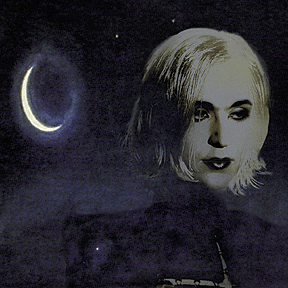
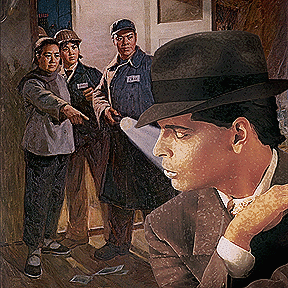
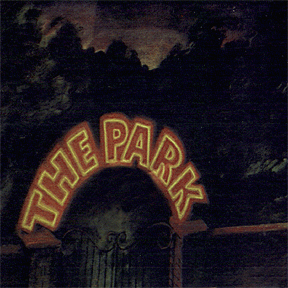
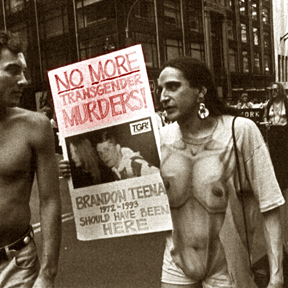
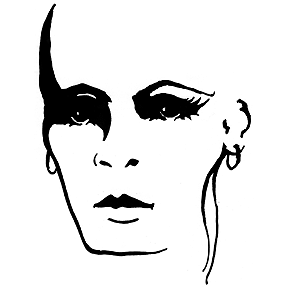
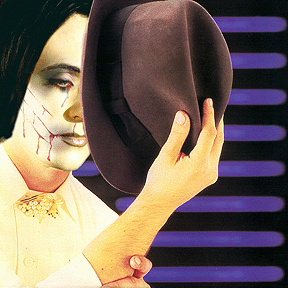
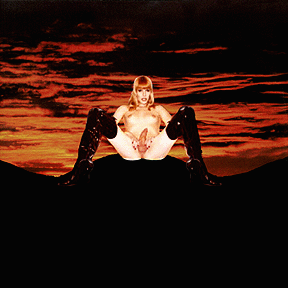
 Originally posted on comatonse.com August, 1999. Accompanying text to the album of the same name (Germany: Mille Plateaux, August 23 1999), CD:MPCD71 Vinyl:MPLP71. Gary Numan cover parodies by Terre, used as slide projections during live performances. Click here to view original release artwork.
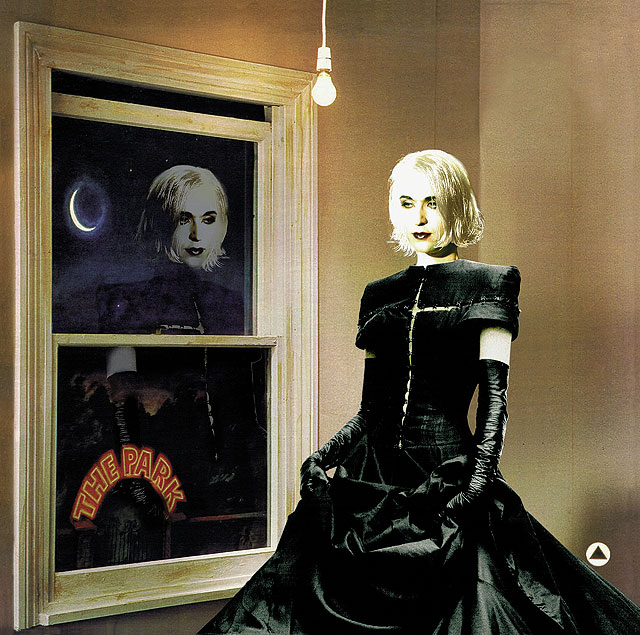
List of Tracks
- Stormtrooper In Drag - released as single
Down In The Park - from Replicas
Dream Of Siam - from I, Assassin
Friends - from Tubeway Army
Sister Surprise - from Warriors
Cars - from The Pleasure Principle
Cry The Clock Said - from Dance
Praying To The Aliens - from Replicas
Slowcar To China - from Dance
Jo The Waiter - from Tubeway Army
Please Push No More - from Telekon
Preface
I purchased my first record in 1979 at the age of eleven after hearing Gary Numan's, Cars, in the now defunct Saints West roller disco in West Saint Paul, Minnesota. Its performance was ceremoniously accompanied by a flood of flashing colored bulbs and swirls of light rings from the mirror ball. With some sleuthing I discovered that the song was not performed by The Cars, as I had first suspected, and eventually located a copy of Numan's record, The Pleasure Principle, in a Target discount store. The album was newly released and fully priced at $6.99, which was more money than I had saved for it. Without hesitation, I removed a fluorescent red "$3.99" tag from another record, covered the true price tag, and proceeded to buy it. And so my consumer relationship to music began with a lie at worst, an ambiguous half-truth at best, an exuberant deception in the name of self-fulfillment in any case. The Pleasure Principle.
The album's synthetic constancy quickly consolidated my hatred of electric guitar (something that would actually present a challenge to my enjoying some of Numan's earlier albums with Tubeway Army). When I could not understand the meaning of Numan's lyrics, I identified with their delivery through his whiney, misunderstood voice on a more personal level - being that I, too, was rather whiney and misunderstood. In my opinion, unlike more utopian techno-pop groups such as Kraftwerk and YMO, the infamous 'coldness' of Numan's music never arose from it's synthetic sounds as claimed by the press. In fact, his music was filled with jazz-like improvisation, fretless bass, piano, and real-time percussion. Rather, it was the manner in which Numan's voice and words exceeded the coolness of his mechanics that gave his records their distinctive emotional detachment.
Throughout my teens I had an admittedly obsessive relationship with Numan's lyrics, spending hours at a time analyzing and rewriting them, trying to map the sexual innuendoes and literary references which never seemed to coalesce into a single image. It was an obsession which led to my parents confiscating my records out of misguided concern for my mental well-being. During my third year in high school I went so far as winning a district-wide poetry competition with a slightly modified copy of the lyrics to Metal, an act of plagiarism which seemed justified in light of Numan's fascination with reinventing himself by stepping into various personas - Gay, Straight, Bisexual, Transgendered, Whore, John, Pimp, Dominatrix, Alien, Machine, Punker, Glammer, Femme, and those ever so awkward attempts at Butch. Having spent my teens scouring his lyrics for some key that would unite these disparate identities in both his music and myself, it would be years before I could comfortably consider that no such unification of identities was required. It was through hindsight that I first began to appreciate how Numan's 'Philip K. Dick'-inspired sci-fi portrayals of Replicas - perverse cyborgs which at first appear autonomously Human, but are actually material embodiments of the cultural production of Human identity - prepared me for better understanding anti-essentialist identity politics, and triggered my disinterest in authenticity and authorship.
The piano solos compiled in Replicas Rubato are drawn from a number of Numan's albums spanning 1978 to 1983. Like my previous album of piano renditions of Kraftwerk titles, Die Roboter Rubato, they were composed through a combination of annotations digitally stepped in note by note, open-meter (rubato) improvisation, and computer aided composition - perverse cyborgs which at first appear autonomously Human, but are actually material embodiments of the cultural production of Human identity. As Replicas of their namesakes, they are lies at worst, ambiguous half-truths at best, exuberant deceptions in the name of self-fulfillment in any case.
           |
Slowcar to Context
- I suppose the things I overheard
were quite by chance
The only story I ever knew or cared for (...knew)
Best left unheard I suppose, don't you?
You look for somewhere to start to look
- Slowcar To China, Gary Numan (1981)
By the time Gary Numan's first album with Tubeway Army was released in November of 1978, it was as much a commentary on the U.K.'s post-Glam scene as it was symptomatic of that time's gender- and sexuality-blurring snares. Taken one song at a time, Numan's highly emotional and personal lyrics conveyed first-hand accounts of sexually deviant experiences. Grouped together, they contradicted one another's claims of sexual fixation and orientation, refusing traditional notions of the 'healthy individual' whose desires reflect a singular and stable personality. Numan's lyrics were also haunted by a reluctant awareness that this post-Glam schizophrenia of desire was conveniently fashionable, implicated in a music marketplace which both facilitated and undermined the sincerity of his first-person narratives. By laying claim to such diverse personal experiences, each with their own investment in portraying different social contexts from an insider's point of view, the larger context of Numan's production and distribution remained vague and fluid.
| 1 All quotes by Gary Numan are recent and provided courtesy of Steve Malins, Manager. |
According to Numan's own account, this elusiveness of immediate context and the need to define one's identity through associations with contexts of 'otherness' could be traced throughout his youth: "The fact that I was sent to a child psychiatrist by my school proved that I was a little disturbed, but to make matters worse, I was fascinated by my own problems. I used to read a fair number of psychology books and identify with mental problems because I wanted to be different."1 Like for so many of us, music and clubs - Gay clubs in particular - with their rituals of behavior and dress separating us from the world at large, were at the center of those few environments which facilitated 'difference' during Numan's teens. Of course, the alluring promise of such environments' communal autonomy and difference - experienced as a highly internalized and personal reaction against 'normality' - is reliant upon denying the influence of dominant cultural norms, even if operating in rejection to such norms. (For example, sporting an entire leather ensemble is as much a defiant statement of impracticality as an allusion to conventional notions of kink, danger and ruggedness.) Once again, the larger contexts which produce difference remain vague and fluid. In Numan's music, then, the use of deviant narratives emerges as an extension of his childhood understanding that one is different, while only being able to engage such an understanding through expressing a desire to become different.
It wasn't until his 1981 release, Dance, at a time when Numan found himself pressed by demands for commercial success and the media's conflicting and bizarre accounts of his own identity, that questions about his context of production became a regular fixture in his narrative fictions. As one might construe from the above-quoted Slowcar to China, Numan had a growing awareness that his alienation from "the things he overheard" about himself in the media was related to a process of alienation in his own modus operandi which was "best left unheard," troubling and dangerously unconscious: the possibility that his fixation with bearing witness to experiences of depravity was operating in response to an unconscious core assumption of his disassociation from such experiences. A disassociation which bore the horrifying implications of a dominant middle-class morality that is defined by the individualist privacy of its own order in relation to the visible disorder of the lower classes - the very morality Numan felt distanced from since youth. In relation to matters of sexuality, then, Numan's fixation with sexual deviance becomes closeted by the ideological underpinnings of his fierce individualism.
A conventional reaction to such a moment of recognition is Existential crisis - the secret weapon of the status quo causing a paralysis of perspective and feeling all attempts at personal expression are foiled by their own construction. Attempts to uncover the truth of one's own difference only results in the shame of implication in dominant cultural ideologies which order our desires for difference. In search of a truth of essence, each claim of deviance becomes a potential lie of essence to oneself and others. Numan's fascination with this perpetual betrayal by the self and others sets the cold tone of his recordings, and sits at the center of his career-spanning obsession with lying, from "He may be lying I can't tell" in 1978's My Shadow In Vain, to the most recent "So I moved like a rumour, Like a glorious lie" in 1997's The Alien Cure.
It is the recognition of this undesired process of self-erasure underlying Numan's works which has shed insight into the dual-edged role of shame in validating and 'closeting' identifications with my own Queerness, and which I find more insightful than any readings of Numan's narratives taken individually and at face value. However, behind their thin veil of sci-fi robotics, the images portrayed in the narratives themselves provide informative documentation of Great Britain's policing of social deviance and Gay male desire during the late 1970s and early 1980s.
Down in the Park
| 2 For analyses of the current policing of Gay cruising in Los Angeles' Griffith Park, see Ultra-red's Ode To Johnny Rio, (US: Comatonse Recordings, 1998) C.005; and Second Nature: An Electroacoustic Pastoral, (Germany: Mille Plateaux, 1999) MP62. |
During the 1970s, Great Britain (as with most Western nations) found itself in the midst of yet another sex panic. Culture was once again at the crossroads of decay, as seen in such symptoms as Glam's fascination with gender-blending and Ambisexuality. In particular, the visibility of Gay male sexuality and cruising in public parks became a target of violent police actions aimed at entrapping and arresting Gay men.2 The potential for seduction by undercover police officers sympathetically soliciting sex from other men was captured in the opening lines to the first track of Numan's premier, self-titled album with Tubeway Army:
- 'Flow my tears'
The new police song
The slogan of peace is
'You must live'
They've got me
And I'm one of them
- Listen To The Sirens, Gary Numan (1978)
Numan's use of "they" and "them" as terms of both association and opposition (which I associate with "police" and "Gay men" respectively) conveys an environment of suspicion, deceit and self-fear which for many men plagued all Gay interactions. The theme of police entrapment appears in several other songs as well, but perhaps none more overtly than the 1979 hit, Praying To The Aliens:
- A random pol' check
'Do you ever think of women'?
They broke him down
Into a torn old queen
Living somewhere between
Dead and dying
There are no more
Do you begin to see?
The corner of my eye
Could give me away
Isn't it strange
How times change
I can't imagine
Living any other way
- Praying To The Aliens, Gary Numan (1979)
Amidst the policing, however, there was one form of cruising which Numan favored as 'safest of all':
- Here in my car
I feel safest of all
I can lock all my doors
It's the only way to live
In cars
Here in my car
I can only receive
....Will you visit me. Please.
If I open my door
In cars
- Cars, Gary Numan (1979)
Of course, the predominant association with the lyrics to Listen To The Sirens is its obvious homage to Philip K. Dick's sci-fi novel, Flow My Tears, The Policeman Said. And, much to my own disappointment and continued surprise, I have yet to encounter a thorough analysis of Cars as a portrayal of soliciting a drive-by hand job (or blow job if you like) - territory for discussion which seems particularly fertile given the song's ascension into history through disco culture. Whereas Numan's narratives lay claim to numerous sexual identities, discussions of his music have typically neutralized the narratives' relationships to specific Queer communities by ignoring them all together. Thus, the potential for Numan's narratives to challenge notions of sexual identity as contradictory lies of essence is diluted through their reconciliation with dominant Modernist ideology as individualist truths of artistic expression.
Engineered
This reconciliation with dominant Modernist ideology leads to a much larger issue which I also struggle with in my own releases: the commercial reduction and/or exploitation of his catalog's Queer contents in relation to the demands of the music marketplace. Under what circumstances would Numan's catalogue represent an exploitation of certain communities, and in what ways has his fascination with lying been used to facilitate the easy closeting and dismissal of Queer contents? How has Numan's establishment as an authentic (true) pioneer of the electronic music marketplace superceded the reception of his declarations of contradiction and lies of essence? How do the implications of these circumstances ensnare this very release?
| 3 For science fiction narratives which combine discussions on sexuality, sexual identity, leftist politics and race, see the writings of Samuel R. Delaney. |
In relation to his own sexual identity, the role of Numan's fascination with science fiction has helped further confuse what parts of his accounts are lies of essence and what are disposable 'fantasies' about aliens and cyborgs. The popular desire to compartmentalize fantasy such as science fiction from the 'reality' of sexual identification has served as an easy way for marketers and the media to 'give the whole picture' by discussing sci-fi allusions while avoiding seemingly unrelated or private Queer contents.3 Yet, according to a 1985 Lipstick Magazine poll of 1500 people about the sexuality of certain pop stars, in which 39% thought that Numan was Gay, 41% thought he was Bisexual, and only 20% believed he was Heterosexual, it seems clear that discussion of Queer contents in Numan's works would not seem out of place for most people. Stripped from the realm of sci-fi genetics and returned to the music studio, Engineers emerges as a rare instance where Numan critically addresses the music industry's manipulation of contents directly:
- We are your heartbeat
We are your night life
...We are your voice
We are your blood flow
We are your eyes
We're all you need to know
We're engineers
- Engineers, Gary Numan (1979)
Confusion as to what parts of Numan's narratives are lies of essence versus sci-fi fantasies has also served as an expression of Numan's personal crisis of identity in relation to the Gay club-based community which both liberated and estranged him. Club owners, managers and ticket agents commonly attempted to solicit sexual favors from Numan and his friends in exchange for passage through the doors to self-expression, all of which framed his early days as a performer. As Numan recalls, "The seediness of those situations left an impression which I used in songs for years afterwards and certainly used on Replicas.... In the songs I exaggerated these experiences, invented some others, set them in a scary, futuristic scenario and wrote about them as if it was all based on first-hand knowledge."
In the songs themselves, Numan's references to machines and wires resonate with the homoerotic overtones of Kraftwerk's Mensch Machine:
- We opened doors by thinking
We went to sleep by dialing 'O'
We drove to work by proxy
I plugged my wife in, just for show
New ways, new ways
I dream of wires
- I Dream Of Wires, Gary Numan (1980)
However, a key difference between the two icons of 70s techno-pop is the manner in which Numan's music is energized with a refreshingly dystopian obviousness about the situation around him:
- Oh look
There's a rape machine
I'd go outside
If he'd look the other way
You wouldn't believe
The things they do
Down in the park
Where the chant is
'Death, death, death'
Until the sun cries morning
Down in the park
With friends of mine
'We are not lovers
We are not romantics
We are here to serve you'
A different face
But the words never change
- Down In The Park, Gary Numan (1979)
I dare say there comes a point when the Homoerotics of Numan's narratives overshadow any sci-fi interpretation.
Music for Chameleons
Homoerotics are only one aspect to Numan's larger agenda of portraying sexual deviance in relation to behavior rather than identity. The sexual object of desire in his narratives does not remain fixed, but traverses between men, women, transsexuals and the self, sometimes within the same song. Yet even in their openness, the Pansexual accounts in Numan's lyrics are plagued by feelings of being torn between people and identities:
- See the strange boy
Keeping to the shadows
He's a very good friend of mine
I've seen you running from the ladies
Don't tell me you're not the kind
I've got the time if you've got the money
Mister you'll be pleased you'll see
We'll meet by the subway
As the screamer cries eleven
And you can have your way with me
You're gonna make me feel so cold
See my one love talking to the pretty boy
I never did like her taste
....Don't touch me with
Your painted little fingers
Cos I know where they've been
You're gonna put those scabs on me
- Friends, Gary Numan (1978)
Other songs remain deliberately ambiguous, if not deceptive, about the gender of Numan's object of desire. Such is the case with Jo The Waiter, a song that Numan says was "named after a girl, Joanna Casey, who was my first love, or as close as you can get at that age."
- Jo the waiter held me close
Behind the door marked 'gentleman'
Just for now that's all I need
Won't someone call me friend
....Everyday I died for you
Valium boys with painted eyes
Young men need love special
I don't think I want it at all
- Jo The Waiter, Gary Numan (1978)
And so every claim of interest in men may be challenged as a post-Glam lie of convenience, and every interest in women may be challenged as a retreat into the 'closet.' During my teens, mulling over this portrayal of Pansexuality as something deviantly different, yet still tortured by the expectations of dominant Heterosexuality, was both informative and disconcerting. It suggested that even when conceptualizing truly 'free' sexual behaviors with people of different sexes, the behaviors themselves are not connected by a truth of essence or the fulfillment of some destiny. Rather, they are connected by the maze of lies one had to maneuver in order to partake in such behaviors, typically with partners who identified as more heterogeneously Straight, Lesbian or Gay.
| 4 For a narrative analysis of the role of shame as a primary impetus for cultural 'development,' see Salmon Rushdie's novel, Shame. For my own analysis of the importance of skepticism and anti-essentialism with regard to pride within 'empowering' contexts such as Queer Pride events, see my album, Love For Sale: Taking Stock In Our Pride, (Germany: Mille Plateaux, 1999) MP58. |
Having myself been categorized and ostracized by others as Gay and Effeminate since pre-adolescence (and to make matters worse, "Terre the Fairy" did have quite a nice ring to it), combined with the subjective complexities of my own internalization of such categorizations before and during adolescence, Numan's narratives were one of the rare places in which I could openly investigate what I experienced as the development of my own identity in response to lies and shame rather than those age-old character builders, truth and pride.4 I found myself scattered between brooding declarations of "Everyone lies" and "Please don't let them lie" (Complex, Gary Numan, 1979).
While I was quick as a teen to interpret the song Complex in relation to circumstantial complexity, as well as a psychological complex, it was the suggestion of an industrial complex synonymous with the music's synthetic coldness which provided a subtext allowing me to begin positioning myself in relation to the construction of my own identity/ies - the location of core identity-related behaviors in socio-material infrastructure, and conceding the role of the social in the fabrication of what I had previously considered my soul.
Of Dreams I Am?
- How I intrude
This impossible room
I still believe
That great American smile
Nothing's ever right
Nothing's ever wrong
But nothing's ever quite like
The stories and songs (nothing ever)
- Dream of Siam, Gary Numan (1983)
| 5 These truths of essence have traditionally been used to naturalize social institutions such as the family, disswaying attempts at reform by ideologically locating their basis in nature. For example, an obtuse biological urge to fuck has come to be accepted as a biological urge to enter a Heterosexual and monogamous marriage to have children, thereby labeling non-Heterosexual and non-reproductive behaviors as aberrations of nature. Certain Lesbians and Gays are similarly invested in proving a biological basis for Homosexuality in an attempt to undermine ideological categorizations of Homosexual behaviors as unnatural. I find this essentialist tactic misguided in its reliance upon Science - perhaps the most complicit of all Western cultural institutions - to identify a Homosexual truth of essence, the biological unavoidability of which is supposed to inspire an ultimately social ideological transformation that will foster acceptance and resolve inequities. In this manner, 'progressive' politics adapt a similarly problematic desire to justify cultural development as the realization of an extra-social nature, once again alienating us from our own capacity for conscious social change based in contextual needs. |
The lie of sexual identity is a special kind of lie. It has the conventional attributes of a deception intended to conceal a material truth of circumstance (such as a secret same-sex partner, or a heterosexual marriage), but within dominant frameworks of essentialist sexual identities and naturalized orientations of desire it also implies a non-material truth of essence (being "born this way," etc.).5 Classic crises of sexual identity arise when we find ourselves involved in behaviors that suggest contradictory truths of essence, betrayals of the self. Nearly all ideological mechanisms of Western culture - from apple-pie Individualist Democracy to religions such as Christianity and Judaism - teach us from an early age that we share a common Human essence which supersedes social context. In light of this commonality, the perpetual question arises: why are there social injustices and inequities of context? Time and again, it is said that injustice is caused by our lack of communion with our Human essence as a result of immorality, lies and deception. And so, to engage that Great American Smile of being able to become anything we want to be, we must abide to conformity via dominant morality. In this way, the status quo (and all of it's social injustices and inequities of context) is preserved, while we believe we are coming closer to understanding our Human essence and achieving the personal fulfillment of living synonymously with our personal non-material truth of essence. The practical result is our ideological blindness to the material mechanisms which alter and perpetuate our social contexts. Whatever truths we may arrive at, then, are limited to their contexts of perception. The manipulation of truth becomes a strategy for manipulating our social contexts.
In the realm of identity politics, the manipulation of truth - specifically whose truth - has become the question of the day. In my own political involvement with issues of representation related to race, ethnicity class, gender, and sexuality, I have found it is the intangible 'invisible biology' of sexual orientation which sets apart the lie of sexual identity as a special kind of lie. It inspires a hate for all seasons which has led to tangles of divisiveness within African-American, Asian/Pacific Islander, Latina and other P.O.C. communities, as well as such communities' alienation from dominant White Gay and Lesbian Liberationist ideologies.
I am not interested in prioritizing discussions of sexual identity above other discussions of identity. Rather, in my attempts to de-essentialize discussions of identity in general, I have found sexual orientation's relation to 'invisible biology' a good starting point for people to consider the necessity to base strategies for cultural change in relation to things which are perceptible and mutable - our socio-material contexts. Even from an essentialist perspective, wherein 'sexual liberation' is commonly seen as the attempted recuperation of the body via the liberation of an intangible truth of essence, there emerges the notion that change does not occur through faith but coordination. Motivation is no longer pulled from the ether, but molded by hands. I have come to have no interest in truths about myself or the communities I inhabit and/or interact with. I am only concerned with addressing context, and attempting to identify limitations of vision in doing so, as a basis for socio-material transformation. In terms of discourse, "my conversation is nothing more than lies" - Conversation, Gary Numan (1979).
She's Got Claws
As inspiration for enacting social change on personal and communal levels, one of the drawbacks of Numan's language is the manner in which it repeatedly capitulates to notions of contradiction as inherently traumatic. His characters are chronically resigned to disparity and confusion. Furthermore, in terms of politics of representation as it relates to experience, certain problems arise from ambiguities in Numan's relationship to such traumas as participant or observer (those "little white lies like 'I was there'" - Down In The Park, Gary Numan [1979]). These ambiguities have at times alienated me from his music, while in other instances have made more palatable some rather tasteless appropriations of identity. The dull conventionality with which lusty Latinas and subservient Asians make their appearances in numerous songs has always disconcerted me. On the other hand, his similarly predictable use of the term 'bitch' has perpetually swayed between unsettlingly brazen misogyny to Queenish camp, depending on what gender one assigns to his object of affection. Yet despite this latter example's performance of the listener's preconceptions, the resulting awareness seems more inspired by Numan's dramatic flair than critical intentions.
She's Got Cause
A relatively consistent element of those rare narrative scenarios through which Numan takes on a voice of defiant empowerment, rather than resignation, is Transgenderism, such as in Stormtrooper In Drag:
- Questions always questions
I'll just speak in slow motion
About obsessions with boys on the floor
Take that smile off your face
Wipe that tear from your eye
Don't say you're sorry for me
Now look at me like a stormtrooper in drag
And I'll let you feel exactly like I do
It's so disgusting I'm so tired of rhythm
And needles in arms
I don't want your point of view
- Stormtrooper In Drag, Gary Numan (1981)
Snappy grrls of the Ambient Internationale in support of needle exchange programs may want to read that last verse twice.
Although typically appearing as sex workers, Numan's drag queens and transsexuals are afforded a confidence relatively absent from his portrayals of selling and purchasing young boys and girls. Perhaps one reason for this interjection of self-determination and control is a connection between his own affinity for mixing make-up with boys' clothing and the idealism of youthful self-expression. Or perhaps he is allured by the arrogance of Transgendered posturing and its fetishistic use of nostalgia (emulating old actresses, etc.) as a means of positioning timeless beauty and other truths of essence in relation to historical context and fad - the ultimate self-deconstructing lie of representation. In either case, it is Transgenderism which emerges as a behavior system capable of consciously spanning the worlds of staged performance and off-stage social interaction:
- We are
Walking nostalgia
Like old movies for real
Look at me, look at you
Look at them, look at us
.....Sell a slim body to the man next door
Like my sister surprise
....We are
The pleasure creation
Gone wrong. Gone wrong
- Sister Surprise, Gary Numan (1983)
It is through this treatment of Transgenderism a deliberate and pleasureful lie of essence that I have come to fantasize Numan finding an ideological exit from the culdesac of ambiguity around his larger context of production, and through which I have ultimately found the basis for a personal course of action. Given the importance of Latina Houses in New York's Transsexual community and elsewhere, it is also through such themes where Numan's frequent use of Latin rhythms takes on contextual relevance, and complicates his music's relationship to polemics of cultural appropriation and audio imperialism.
Me! I Disconnect from You
I am ending this text with an answer to the question of Numan's sexual identity, the disclosure of which simultaneously cemented and ignited every obsessively placed tinder in the theoretical framework I have built in my mind around Numan's work. It was nonchalantly disclosed by Numan's manager in response to a question which I had never asked, and considered rhetorical in any case - an irrelevant truth of essence conveyed via wires, dumbing my ears in telephone conversation and made material amidst spools of faxes. As an answer which does more to question audience expectations than to clarify Numan's experiences, it remains a lie best left to Numan's own words:
- I don't believe you
You said 'straight'
It's like giving up hope
- She's Got Claws, Gary Numan (1981)
Join Boys Like Us, a mailing list established to discuss Queer thematics in Gary Numan's music. The list, originally started in response to homophobia and abuse on the regular Numan mailing list, is open to all Numanoids regardless of sexuality or gender.