|
terre thaemlitz writings 執筆 |
|
Please tell my landlord not to expect future payments because Attali's theory of surplus-value-generating information economics only works if my home studio's rent and other use-values are zero - Terre Thaemlitz |

 Originally posted on comatonse.com August, 2008. First presented at "Non-Simultaneity and Immediacy: Utopia of Sound," organized by Diedrich Diederichsen and Constanze Ruhm at The Academy of Fine Arts, Vienna, May 29-31 2008. Published in "Non-Simultaneity and Immediacy: Utopia of Sound", ed. by Diedrich Diederichsen and Constanze Ruhm, (Austria: 2009). Read a review of the book from The Wire (UK).
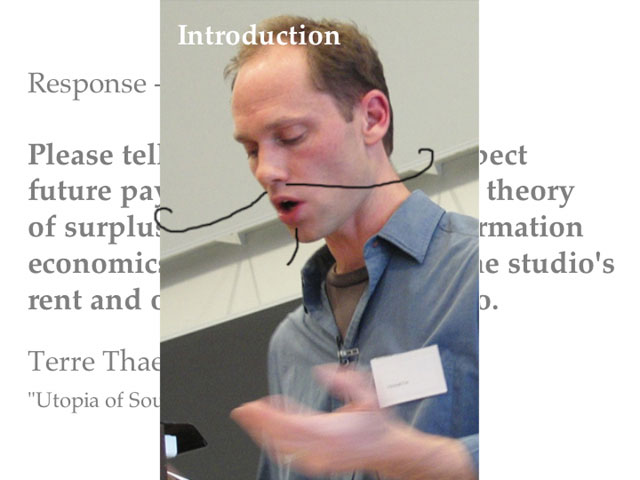
Introduction
|
1 Ruhm, Constanze, "Non-Simultaneity and Immediacy: Utopia of Sound," symposium keynote (Austria: Vienna Filmmuseum, May 29, 2008). 2 Christoph Cox, "Space, Time, and Sonic Utopia," symposium presentation (Austria: Academy of Fine Arts Vienna, May 30, 2008). Special thanks to Christoph for his patience and good humor during my presentation. |
Or perhaps I might criticize the way he starts his narrative with the assertion, "sound is time or it is nothing at all," attempting to contrast notions of space and time, when in fact sound is a phenomenological example par excellence of the intersection of space and time. There can be no sound waves without vibrations traversing three dimensional space. So at a future symposium with a different theme we could exclude time from the formula and just as assertively say, "sound is space or it is nothing at all." But what comes out of both assertions is an absence of the listener. We find ourselves discussing space, but not context. Time, but not history or memory. Christoph's initial act of severing the connection between sound-space and sound-time secretly performs a parallel task of severing the relationship between sound and audience. It insinuates that "raw sound" as phenomenon devoid of societal or personal interpretation carries some form of intrinsic informational value prior to our consideration of such sound (in this case, a value to inform the manner in which we proceed to consider and discuss said sound), or that the physiological experience of a listener may be extricated from the interpretive processes associated with bodily reception and appreciated in a precognitive state - although appreciation is a cognitive act. This is the conventional High Modernist position - the potential for sound-as-sound within the plastic constructs of musicology, or color-as-color within the plastic constructs of painting, or form-as-form within the plastic constructs of sculpture, or time-as-time within the plastic constructs of happenings and installations. It is a notion of materialism that, even when exhumed in the name of materialism with the aim of demystification, excludes and betrays the very notions of experientiality it claims to bring into focus. It betrays the social. This is precisely why I resent Art contexts - particularly "political Art" contexts - because this ideological corpse is always, always propped in the corner, its stench creeping like an all-enveloping glowing green fog. I say "corpse" because it had been laid to rest a century ago by the likes of Grosz, Herzfelde, Heartfield, Duchamp and countless other canonical figures we claim to have learned from. Yet in 2008 we remain so saturated with its odor that it has become commingled with our own cultural scent, only occasionally wafting into our consciousness for brief intervals like the subtle tang of one's own body odor at mid afternoon, to be ignored in the hopes that one's own denial shall make the scent unnoticeable by others and not warranting of a thorough shower. [Discretely sniff armpit to check for odor while pretending to believe the audience does not notice.]
| 3 Actual time. |
| 4 Cage, "A Composer's Confessions" [1948], in Kostelanetz, 1993, p.43. |
| 5 At the symposium, an edit of the climactic final refrain from the song "Vienna," by Ultravox, was used as the opening theme, looping the phrase, "This means nothing to me, oh, Vienna..." |

Part I: Celebrity Rock Band Tour Kuwait/Afghanistan
- CELEBRITY ROCK BAND TOUR KUWAIT / AFGHANISTAN
Professional Celebrity Rock Music Band, sought for tour of Forward Operating Bases in Kuwait and Afghanistan. Musical repertoire should consist of Southern rock, pop rock, post-grunge, and hard rock. At least one member should be recognizable as a professional celebrity. The Government will conduct a performance risk assessment based on the quality, relevancy, and recency of the Offeror's past performances as they relate to the probability of successful accomplishment of the required effort. Performers shall be wholesome and adhere to the standards of good taste: profanity, vulgarity, or connotations of sexual depravity and perversion will not be used. Female entertainers shall be displayed in ways not offensive to the host nation. Protective military equipment, such as Kevlar, body armor, and eye and ear protection, will be provided when the group is traveling on rotary or fixed-wing military aircraft. Any criminal conduct, unexcused tardiness, indecency or obscenity, drunkenness, use of narcotics or hallucinatory drugs, or damage to Government property will be grounds for termination of the contract.
ACA, US Army Contracting Command Europe
Solicitation Number: W912PE08T0064
Posted: January 11, 2008
Awarded: January 28, 2008
Award amount: $70,220 USD6
| 6 US Federal Business Opportunities website (fbo.gov), January 2008. |
My opening with this job solicitation for rock musicians by the US government is not as ironic or sarcastic as it may first appear. In his presentation, Christoph discussed Michel Foucault's distinction between notions of utopias, or unreal yet analogous spaces separate from daily living, and heterotopias, or real spaces perceived through mythic systems in which people stage extraordinary experiences. Utopias, albeit fantasies, are always in some aspect analogous to the real, and we are told - such as by churches and governments - that the contrasts between utopian ideals and daily living help motivate our participation in social realities by twisting our disappointments with those realities into desires for the unattainable. We are taught that we as a species need to dream in this manner, and that this delusory process of manipulating our material disappointments into hope is "normal" and "healthy." At the same time, largely as a result of the stress of daily life, heterotopias exist to contrast with daily social patterns as places of ritual and rites of passage (such as churches and schools), places of release (such as festivals), places of rehabilitation (such as prisons or hospitals), etc. In that heterotopias are a kind of material link to something other, Christoph framed the experience of heterochronia, and heterochronic sound, as something that can be "liberating" in an experiential sense - even en masse such as at a concert or religious ceremony - but in relation to socio-political process I believe this sort of "liberating experience" must be distinguished from concepts of social liberation, ie. systemic transformation. As Foucault described in his fifth and sixth principles of heterotopias:
- [They] always presuppose a system of opening and closing that both isolates them and makes them penetrable.... They have a function in relation to all the space that remains. This function unfolds between two extreme poles. Either their role is to create a space of illusion that exposes every real space, all the sites inside of which human life is partitioned, as still more illusory.... Or else, on the contrary, their role is to create a space that is other, another real space, as perfect, as meticulous, as well arranged as ours is messy, ill constructed, and jumbled.7
| 7 Michel Foucault, "Des Espace Autres (Of Other Spaces)" (1967), French journal Architecture/Mouvement/Continuit, 1984. |
Whereas Christoph discussed heterotopic systems of opening, I would like to consider the functions of their systems of closing which, without focused consideration, might easily be dismissed as less important than the "liberating experience" of opening.
The breaks in daily rhythm triggered by heterotopias - those heterochronic shifts in time - may invoke a sense of chaos, but they are rarely chaotic, and often outrightly planned. Think of Cage's need to score 4'33", including page turning by the performer. I have recently been involved in a project that remixes his catalog, and I can assure you the lawyers, publishers and record labels - all of which I can honestly say have been very cooperative and friendly - are nonetheless all very organized and in contact around the control and use of his works. I had read about Cage's work, but I confess I had not actually heard much of it before working on that remix project. After hearing over 20 albums of recordings, I was overwhelmed by his inability to escape musicality. In listening to performances of his compositions I lost any lingering hope of dissonance between their promise of rupture and their commercial administration. Their heterochronic passing through the same stereo speakers on which I play albums by George Michael and Sade occasionally offered liberating experiences, but nothing that could be mistaken for liberation. They did not break my stereo. They were disappointingly beautiful.
Heterochronia's orchestrated palpitations are part of all social structures, and their overwhelming function is to re-sync us with daily life. The sound of heterochronia could be the noise and base humor of morning radio shows intended to physically and mentally jar us from our sleep, or the background music at fast food restaurants which accelerates our eating and departure, or the background music at department stores which clouds our perception of time passing while shopping. In our daily lives we are constantly moving through heterochronia after heterochronia, many of them sound based, and all of which are compared to the steady metering of our watches that within a single day will be in synch with our senses, ahead of them, and painfully lagging behind them... You have undoubtedly been experiencing these times slips first-hand while occasionally glancing at your watch throughout this conference. And in heterochronia's complicity with daily life - it's being part and parcel of the social rhythm, like the body experiences countless sneezes, or palpitations, or orgasms - heterotopias seem to be definable by their potential for duplicitous parody. The parody of crossing social boundaries, of redefining space and experiencing multiplicities, while in fact simply enacting fantasies of otherness. They rely upon a suspension of disbelief, in which the mundanity of social relations may be perceived in heroic terms and regain their allure to minds numbed by daily monotony. For example, consider the massive suspension of disbelief held by those who insist the notorious Burning Man rave-festival is an amazing, life changing experience, as opposed to a urine-stenched cesspool of co-dependent humanists out to prove their capacity for self management. Burning Man is a staged parody of the attendees' desire for faith in their own human goodness. It is a willing subjugation to the spiritual in an age in which many First World inhabitants feel untouched by the social dangers of enforced religious praxis. A duplicitous parody.

Part I: Celebrity Rock Band Tour Kuwait/Afghanistan, Pt. 2
| 8 "Shock and awe" was the infamous term used by the US military to describe their rapid dominance blitz on Bagdhad in 2003. |
| 9 Foucault. |
For example, for Karl Marx it was the point where Historical Materialism gave way to Communist fantasy; the fulcrum between looking backward and looking forward. For Jacques Attali, it is the point where an analysis of the social functions of sound give way to a desire to see music as a prophetic medium; the fulcrum between music as a manifestation of social currents and music as something transcendent of or proceeding material praxis, which has ultimately given way to a non-material notion of information based economics. In either case, it is a willing if not unwitting retreat to thinking within the boundaries of "accepted knowledge." It is where criticality about one's context is seduced by a presumption of understanding one's context, almost like a mathematician, whereby formulas intended to elucidate the flow of variables become the rules to which variables are subjected. (In social terms, people are the variables passed through social formula after social formula.)

Part I: Celebrity Rock Band Tour Kuwait/Afghanistan, Pt. 3, Homotopia
When I read this advertisement seeking applicants for a rock band tour of military positions in Kuwait and Afghanistan, I see musical performance represented as a heterochronic event intended to rupture the utopic ideals behind the battlefield, which is in itself a heterotopia of crisis. We can clearly see music functioning simultaneously as a device of experiential rupture (the rock concert as an "escape" from the trials of warfare), and as a device of mainstream reconciliation (the rock concert as an exercise in "normalcy" amidst social chaos). If the "hetero" in "heterotopia" refers to a notion of "difference" between standard and heterotopic social space, then perhaps we could refer to this homogenizing reconciliation of heterotopic space with standard social space as a "homotopia." (I realize that sounds like the name of a weekly party at a Gay nightclub, but in this instance take "homo" in its root form of "sameness" which is in opposition to Queerness.) Like Burning Man, this rock tour is a staged parody of the organizers' and attendees' desire for faith in their own humanity amidst the inhumane. But unlike Burning Man, that sense of reconnecting with one's humanity and capacity for self-management does not focus on a mythology of the "other," but deconstructively points back toward non-military life, the life before, the life to come again. The passage of time in such a concert is simultaneously heterochronic in it's ability to entertain and distract the soldiers, and homochronic in it's ability to invoke nostalgia and "normalcy" in a zone of social instability.
Heterotopias conceal homotopias. Implicit in the construction of heterotopias is a moment of reconciliation with conventional social spaces; the fact that ceremonies - symposia - come to an end and we can finally go have dinner. While there are heterotopic lifestyles that attempt to exist in a state of sustained and controlled heterochronia out of sync with daily life, such as nuns or yoga gurus or deadheads or vegans or artists or professional musicians or transgendered persons or queers or carnival roadies, we find that our activities as gatekeepers of heterotopias remain framed in relation to conventional daily life, and in fact set the boundaries for conventional daily life. We see how civil rights movements shift these boundaries, moving traditionally heterotopic communities such as "Gays" and "Lesbians" into definitions of the mainstream by opening those communities' heterotopic rituals to the spaces of "daily life" until they lose their sense of otherness. Rituals of difference and PrideTM which simultaneously perform a homotopic function of reunification with the mainstream, celebrating our "normalcy" above all else. The phrase "we are everywhere" no longer implies that the person next to you at the office or in church may not be who you think she is, but declares the arrival of the self-identified Queen you'll just have to live with from now on. Looking at transgenderism, in most cases it is a heterotopic lifestyle that is inseparable from individuals' desires for social reconciliation; a heterotopia of crisis in which an abandonment of male or female gender signifiers is usually coupled with a homotopic immersion in the opposite signifiers. The quest for passability is the quest for reconciliation with the status quo. Heterotopic lifestyles actually serve to amplify our subjective crises, traumas, desires and fears around social abandonment. They are orchestrated homotopic responses to alienation. They define and stabilize our relationships to dominant culture, as unstable as the conditions of daily existence may be.
I believe these homotopic undercurrents to heterotopias wittingly or unwittingly inform, even undermine, our critical attempts to develop and experience social relations in ways that challenge canonical models of knowledge and experience as accumulative. A heterotopic experience carries with it a counter-revolutionary impulse - not counter-revolutionary in the sense of preventing revolutions from happening, but as an impulse to minimize all the potential shades of social, emotional, physical, and economic violence the term "revolution" implies, no matter how warmly the term has come to be used (such as with the "internet revolution," or "musical revolution," or "revolutionary hair care products"). If utopias lead us through our daily lives while pointing us toward myths of stabilities deferred - that mythical island of Thomas More's upon which we are conditioned to pointlessly hope to one day beach - heterotopia's lead us through atypical rituals all the while returning us in the undertow to an ocean of mythical stabilities obtained. Myths of stable access to food, shelter, medicine, physical safety, and self-direction in daily life. Myths that fail to lose power despite our knowing they are only vaguely applicable to less than one out of ten people on this earth. Myths so powerful that none of us here now show signs of feeling - of intensely experiencing - the horror and suffering that last sentence entails. I don't point that out to invoke liberal guilt. I point it out as a function of listening, of understanding the words without deeply registering the material circumstances they represent. Perhaps this ambivalence conjured by my passing words on global strife is the closest we can come to the abstract and detached notion of "sound as time" that Christoph spoke of. It is an informational dead time of sorts in which we experience our comprehension of sounds and language passing without affect. Ambivalence - a-politicality - appears before us as the holy grail in the Modernist quest for "pure experience." [Once again, discretely check armpit for odor.]

Part II: Attali-schmattali
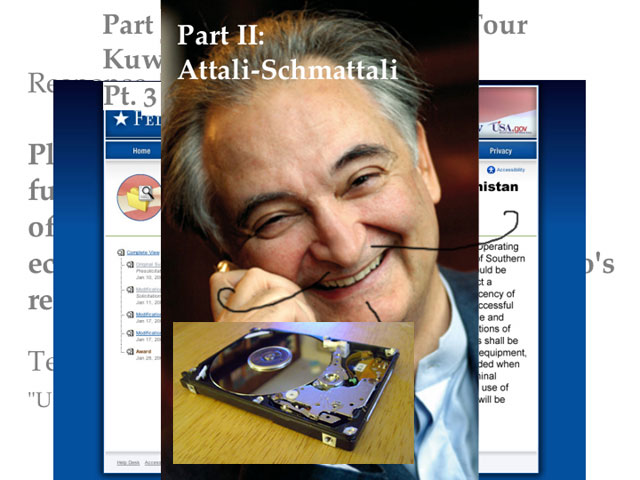
In relation to music, I read this denial of circumstance - denial of the micro-social and global exploitations inflicted in the name of First World standards of living - into the ideologies framing our transition toward download audio, and the obsolescence of CDs and other product-based media formats. Through downloads, music is gradually being recast as a matter of "pure information," the rhetoric of which makes us further lose sight of the material methods of such information's production and distribution. At the forefront of this misinformation is Jacques Attali, who said at the 2001 Cybersalon Net Music Conference:
- Music is very specific for a number of reasons. One economic reason is that music is pure information. In economics, information is a devil - it's impossible to manage. For example, the whole of economic theory is the theory of scarce resources... but it doesn't work for music; it doesn't work for information as a whole. If I have a pot of milk, and I give it to you, I don't have it anymore. But if I give you a piece of information I still have it, I keep it. Which means that if I have something and I give it to you, I create something new: abundance. And this means that economic theory doesn't work for information, when that information can be separated from its material support - a CD, or whatever is the case today.... In an information economy, something has more value when a lot of people have it. For example, if I am the only one to have a telephone, it doesn't mean anything, not if there is no one else to call.... We must be very careful, when we speak about music, not to have in mind the main economic laws.10
| 10 Jacques Attali, transcript from "Cybersalon Net.Music" conference, May 2001, printed in The Wire (UK: The Wire Magazine, Ltd., Issue 209 July 2001), p. 70. |
Digital audio finally brings recording and distribution processes in synch with other Modernist archival systems such as museums and libraries. As Foucault described:
- Museums and libraries are heterotopias in which time never ceases to pile up and perch on its own summit, whereas in the seventeenth century, and up to the end of the seventeenth century still, museums were the expression of an individual choice. By contrast, the idea of accumulating every-thing, the idea of constituting a sort of general archive, the desire to contain all times, all ages, all forms, all tastes in one place, the idea of constituting a place of all times that is itself outside time and protected from its erosion, the project of thus organizing a kind of perpetual and indefinite accumulation of time in a place that will not move - well, in fact, all of this belongs to our modernity.11
| 11 Foucault. |
Self-described audio-activists Ultra-red explored this absence in their 2006 project An Archive of Silence, which is available for free download from their fair-use archive Public Record (publicrec.org). The project uses Cage's 4'33" as a metaphor for what they term the current "epidemic of silence" around AIDS within the US generally, as well as in relation to the increasingly inaudible noises of contemporary AIDS activism - activism that had once rallied around the slogan "Silence=Death." An Archive of Silence is largely compiled of "performances" of Cage's 4'33" constructed from recordings and sounds of the US AIDS activist movement. However, if Jacob Kirkegaard's project of the same year Four Rooms, which Christoph described to us, is about space, time, and the sonic memory of what once was in Chernobyl's radioactive chambers, Ultra-red's Archive is about a silence of material absence - the literal absence of audio materials from which to draw upon, despite the media-heavy tactics of groups like ACT-UP - and the memory of one's own participation in those lost moments. It is an archive of the absence of archive. An archive of sound as memory. In the annotations to 4'33" (Arrest Record #1, County USC Hospital, May 22, 2004), Ultra-red members return fourteen years later to the site of a cornerstone demonstration on May 20, 1990, which forced the Los Angeles government to open an AIDS clinic at the hospital. Similar to Kirkegaard, Ultra-red contemplate the recording and filtering of residual sound waves from the past - in this case, to isolate and honor the voice of the demonstration's driving force, ACT-UP member Larry Day, who died of AIDS prior to the ward's opening. But unlike Kirkegaard, who relies upon a pseudo-scientific myth of having captured and filtered an audible record of previous times, Ultra-red immediately address the impossibility of their objective by today's technological standards:
- If I'm going to return to County USC Hospital for this purpose, with microphone in hand, I owe it to Day to invoke his name and his history. Perhaps in that invocation I may retrieve some sort of trace echoes of that day in 1990. To do so, I would need an especially sensitive microphone. I would also need to calculate the exact density of a waveform after fourteen years of decay. What conditions would require me to modify such calculations: the temperature of each day that passed between May 20, 1990 and the present? What about the conflagration that followed the trial of the officers accused of torturing Rodney King? I might need to consider the impact of vibrations from the Northridge earthquake of 1994. Then there are the daily vibrations from buses, helicopters, sirens, passing jets, construction, the nearby train tracks, passing trucks, low-riders with their booming bass, motorcycles, the daily waves of people streaming in and out of [the hospital's] doors, footsteps, voices, cries and the calls of the nearby street vendor.12
Given these technological limitations, Ultra-red turn to the question of memory:
- Suppose I was capable of making the necessary calculations. Suppose there did exist recording equipment sensitive enough to excavate the sounds of voices from fourteen years ago. Suppose the equipment was able to encode the frequencies onto digital audiotape, giving us a record of that exact event and my participation in it. Suppose all these things, the question remains whether I would be able to recognize those sounds as the trace index of what it is I remember of that day. Would I even recognize Larry's voice amidst the digital noise - noise which signifies my experiences with the pandemic today?13
|
12 Ultra-red, An Archive of Silence, (US: Public Record, 2006). 13 Ultra-red. 14 Ultra-red. 15 Ultra-red, "After the bedroom, or, on exceeding demand," (US: Public Record, 2004). |
Thus it is a politics of recognition and memory - documented or not - that drives Ultra-red's relationship to silence. The interpretation of the record, the reception and construction of sounds themselves, is subjugated to the social act of listening. Modernity's mythological potential for embracing sound-as-sound, and all the distractions such myths bring to a socio-political discussion, is diffused so as to better facilitate an actual discussion of material relations extending beyond aesthetic affect. As Ultra-red states, they have "developed a methodology: a fixation on recordings. There is only a record. If our political actions are the result of reflecting on the record, can politics be possible where no record exists?"14 Their fair-use archive Public Record itself is an attempt to create just such a record, under the banner, "The record only exists in its excavation. The record demands to be used. And the record exceeds the demand."15
| 16 See "Operating in Musical Economies of Compromise (Or... When do I get paid for writing this?)," in Organised Sound (UK: Cambridge University Press, December 2001, Volume 6, Number 3), pp. 177-184; and "El iPod está violando a los violadores que violaron mi pueblo: Una perspectiva económica de la producción de audio contemporánea (iPod is Raping the Rapists Who Raped My Village: An economic overview of contemporary audio production)," in Zehar: Revista de Arteleku-ko Aldizkaria, (Spain: Arteleku, 2005, No.55). After my presentation, another speaker told me about the problems she and others have had with accusations of "self-plagiarism" when repeating oneself, in some instances resulting in loss of payments, etc. Sadly, beyond the ideological contradictions conjured by many publishers' bizarre insistence upon "originality" (particularly when dealing with themes that take a critical stance toward notions of authorship), I find their main concern is usually simply one of "getting what they paid for." Since many magazines and journals pay by the word, they consider such repetitions as a matter of the author "cheating" the publisher out of their requested word count. |

Part II: Attali-schmattali, Pt. 2, Use-Value=0
When this archival impulse combines with download technology, the scale of our home collections also begin expanding in odd and infinite directions. While looking to download a song using BitTorrent, Limewire or similar file sharing software, how many of us have ended up downloading a hideous discography of ten or more albums by some artist from which we only knew, only wanted to hear, and only will every listen to one song? Although one may attempt to draw parallels between such easy access to file collecting and, say, the carefree collection opportunities offered by one euro used record boxes at flea markets, it seems we as individuals are entering a digital audio heterotopia in which our home collections cease to be the expression of our individual choices in favor of a sort of general archive. It represents an informational dead time of sorts in which we experience our comprehension of sounds not only passing without affect, but often without playback or any possibility of listening to it all... without duration.
Statements such as Attali's which purport all of this access to information marks our entry into a new economic phase are generalizing statements that could only be made by people in those minority of countries such as ours where we have the luxury of excessive access to information archives. Its arrogance becomes apparent when compared to something such as the underground library movement in Cuba, in which disconnected groups of one to thirty people secretly store a small collection of books, any books, only to be periodically raided with the opositors imprisoned and the books burned. Ultimately, the ideological underpinnings of our bold, new information economy are straight in line with the development of traditional capitalist systems in which all experience is reified and regurgitated in the form of abstract relations. As capitalist processes become more refined and unhindered in the post-Soviet era, it seems only logical that we find it difficult not to conceive of abstract information - of our own knowledge - as external commodities of the ether for barter. To paraphrase from Karl Marx's Capital, we might say that information, like use-value, "possesses the peculiar property of being a source of value, whose actual consumption, therefore, is itself an embodiment of labor and, consequently, a creation of value." But given that information starts in worthless singularity (such as a thought), it can only be traded for its "surplus-value" through transference and replication, in which case it "reproduces the equivalent of its own value [zero], and also produces an excess, a surplus-value, which may itself vary, may be more or less according to the circumstances." As information only takes on value in the late phases of surplus-value once it is somehow recorded, it becomes easy to dismiss the materials of information development (such as my home-studio production time), which assumes a corollary use-value of zero. We enter the world of the "no overhead" bedroom studio capable of yielding pure profits, forgetting about the actual costs of studio gear, space and utilities. Economically, the advent of the bedroom studio meant an album's "advances" that were traditionally paid in advance in order to subsidize studio expenses (imagine that), are now typically paid on or after an album's release, and are considered advances strictly on the future sales revenues of the end-commodity itself. Labels act as though the "bedroom musician" produces audio with no raw materials, auxiliary materials, instruments of labor, cost of living, nor any other material expenses. Audio without overhead. Therefore, we can see that the ultimate underpinning of Attali's information economics is no more than the capitalist dream of profits unmitigated by circumstance.
Part II: Attali-schmattali, Pt. 3, Use-Value=0, Google=1
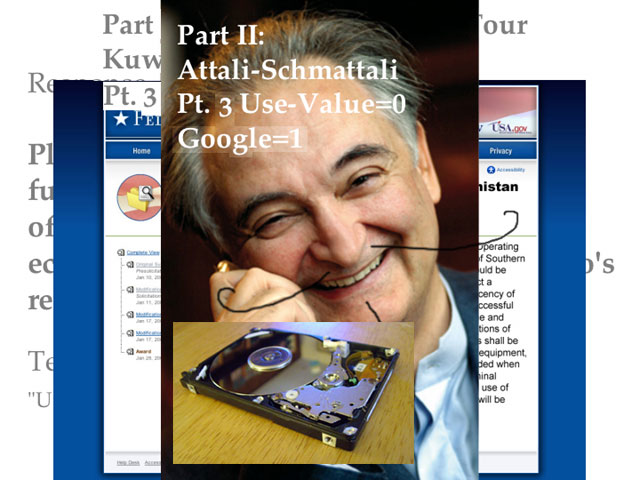
The technology industry refers to this ethereal internet-based information economy as "the cloud," but given its ecological reality it would be more aptly referred to as "the smog." Lurking in the vapor are server storage facilities by companies like Google, Microsoft, Yahoo, Ask.com and AT&T, each currently consuming enough megawatts of electricity to power a town of about 80,000 homes, or the World Trade Center at peak power on a hot summer day. These facilities require a half-watt in cooling for every watt they use in processing, just so we can troll through petabytes of data on key words such as some of 2007's most popular searches, "iPhone," "Pavarotti" and "Radiohead." In the US, Google, Microsoft, Yahoo and Ask.com are all building data centers along the Columbia River, demanding handouts from local officials in the form of tax exemptions, assurance of cheap energy rates from state-owned power facilities, and city-funded fiber-optic connections. As was noted in the March issue of the US magazine Harper's:
- The EPA [Environmental Protection Agency] estimates that by 2011, US data-center power use will double, but a quirk in its accounting excluded Google from the study.... In 2006 American data centers consumed more power than American televisions. Google... and it's rivals now head abroad for cheaper, often dirtier power. Microsoft has announced plans for a data center in Siberia, AT&T has built two in Shanghai, and Dublin has attracted Google and Microsoft. In all three locations, as in the United States, the burning of fossil fuels accounts for a majority of the electricity. Google is negotiating for a new site in Lithuania, disingenuously described as being near a hydroelectric dam. But no matter where the data center is located, Google will be tapping into Lithuania's power grid, which is 0.5 percent hydroelectric and 78 percent nuclear.17
| 17 Ginger Strand, "Keyword: Evil - Google's addiction to cheap electricity," in Harper's Magazine (US: March 2008), p.65. |
Clearly, any attempt such as Attali's to represent information as something other than record is an ideological affront. The non-materiality of data, the very idea of engaging our own process of thinking in outer-body ways (as alluring and even vital that may appear to those with a spiritual disposition) is the grandest of social ruses duping First World publics today. It is a lie that drives economic bubbles and market crashes, hammering deeper the wedge between rich and poor, all through the absurd promise that we too might become overnight millionaires or some other mythical figure of late-capitalist freedom. In specific relation to music consumption, who wants to pay for downloads by unknown producers when major acts like Radiohead give away albums for free? And so everyone is eager to give away their commercial-oriented audio for free in search of their "big break." Their chance to be Radiohead. Not Radiohead as the musicians who give away music for free, but Radiohead the artists who are financially capable of giving away their music for free without personal repercussion.
| 18 On this theme, after participating at "Non-Simultaneity and Immediacy," I spent the following two weeks at York University's Sir Jack Lyons Music Research Centre where I recorded what is likely the world's first full-length MP3 album, a thirty-one hour piano solo titled, "Mediation on Wage Labor and the Death of the Album." The recording will eventually be released as a single 3.98GB 320kbps MP3 audio file (FAT32 System File compliant, less than 4GB) on DVD-ROM. As with most albums, the actual recording session had to be faded out in order to fit the media format's limitations - in this case, the acoustic performance (recorded in sittings of 3 to 6 hours) was edited to a little under thirty hours in order to keep the file size under 4GB. Live performances of the piece shall always be at least eighty-one minutes long, exceeding the length of an audio CD. However, the difficulty of staging a "full performance" of thirty-one hours clearly indicates the historical end of any practical relation between the length of concerts and the excessive album durations allowed by contemporary media formats. As the 4GB size of the MP3 file is currently too large for convenient download and gives unpredictable playback results with some computers and MP3 players, it highlights the current boundaries of MP3 media performance (although it can be assumed that the majority of playback problems will disappear with future improvements in the ways operating systems handle large files, and increased internet bandwidth, at which time a new analysis of the boundaries of the "album format" should be considered). The effects of these ongoing changes upon the relationships between a producer's labor, production wages/royalties, and performance wages/royalties should also be monitored. |
The only reason I could develop and produce the audio projects I have released is because I demand to be paid for my labor. To complicate things, the lack of employment opportunities in this niche field (particularly in countries without public arts funding) means record advances or performance fees must cover one's living expenses between paying events. It creates a kind of economic heterochronia in that one can no longer think of labor in terms of an hour's wage for an hour's work, but rather a series of brief and disjunctive behavioral bursts for which financial compensation is rationed on a glacial scale of weeks, months, quarters, half-years, years. So long as daily living expenses are covered, my work at home continues, seemingly independent of income. The money received from this event will go toward the manufacturing of a vinyl record (to be precise, the John Cage remix I mentioned earlier), or some dental work. When my luck runs out and paying opportunities cease, or if recent computer tracking makes crossing borders without proper work permits supplied by my employers too risky, I will direct my energies elsewhere because: 1) I will be unable to eat or pay my rent, and 2) I have no intention of supporting the myth of a goodwill-based music industry or any other industry of cultural production. Our reckless extension of goodwill is ultimately an act of self-sabotage. The impassioned artist's stance, "art for art's sake," obfuscates a labor issue. The iconic struggling artist who volunteers her work is a scab, but does not know it. If demanding payment for our labor means culture industries would collapse, then so be it. Perhaps we would finally begin conceiving of cultural production in terms larger than industry. Or more likely, we might find that we cannot exist without those industries which fail to support us, making us already pathetically irrelevant. Either way, I shan't be mourning.18
Introduction, Pt. 2, "And Still To This Day, I'm Baffled By That"
If, as Ultra-red points out, recent decades of conventional activism and the act of demanding has often left us without audio records other than sound subjugated to video; and if the majority of orchestrated heterotopic audio interventions fail to address their own homotopic roles in supporting the politics of daily life we presume them to be other-than; what other ways are there to conceptualize sound as not only social, but political... particularly when the sound of politics is more often than not the silence of memory?
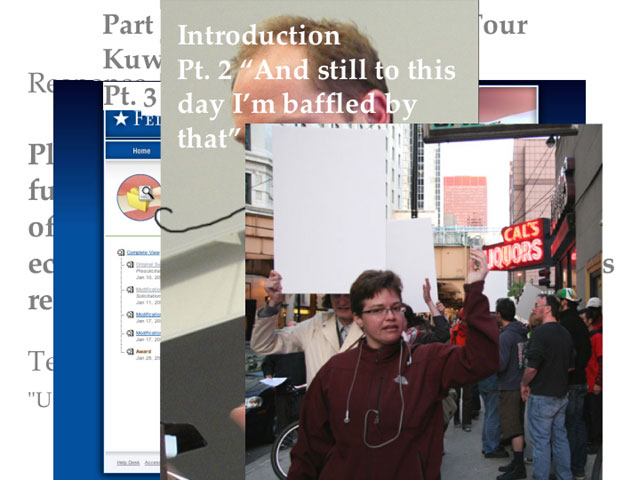
Ultra-red has recently attempted to address this issue in a series of performances for public space entitled Untitled (for large ensemble), which was held once in Los Angeles in November, 2007, and more recently in Chicago this May, 2008. Ostensibly billed as an audio performance, the "ensemble" creates a gathering point for "regional individuals involved in social justice work," ranging from activists to grassroots community organizers to NGO and social service employees, all of whom hold blank white placards and proceed to publicly demonstrate without an articulated demand. Time keepers mediate the rotation of voices in solo or chorus. The ensemble members may repeat predetermined chants such as, "And still to this day, I'm baffled by that," or spontaneously testify. Silences arise in times allotted to invited soloists who failed to show, perhaps occasionally filled in by another participant or onlooker or the ambient sounds of the sites themselves. It is only at the end that the participants are asked to write on the placards, prompted by the question, "What did you hear?" If Cage's 4'33" challenges the attendees to confront their desires for entertainment value, Ultra-red's Untitled challenges the attendees to confront their desires for witnessing and contributing to social transformation. Unlike Cage, who points us to a vague notion of the world as it exists despite us, Ultra-red points us to a world in which we plan, act, listen and remember.
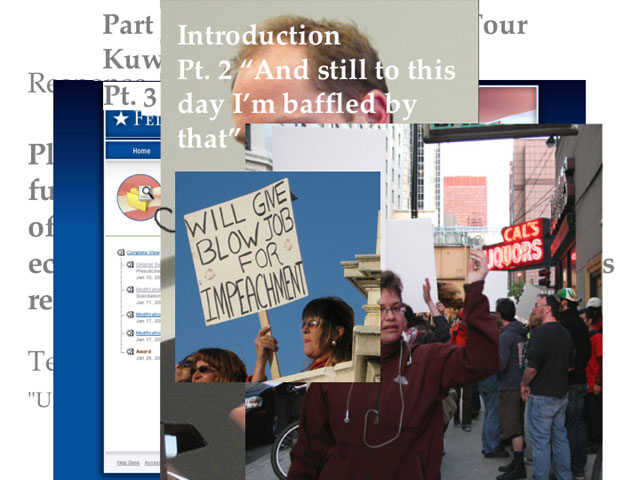
When I first saw images of Ultra-red's Chicago performance, I mentioned to them that I was struck by an awareness that within the economy of signs around activism the placards were missing the traditional wooden sticks used to lift them higher. I recalled my own experiences with ACT-UP during the late 1980's in which people had to stop mounting signs to sticks because the police claimed they were weapons, confiscating the signs and at times arresting the carriers under quite serious charges such as "possession of a weapon on (city/state/federal) property," "intent of assault on a (city/state/federal) operative with a weapon of force," etc. . Of course, we all know that a stick in the hands of a police officer is, indeed, a weapon, but the implication that our material attempts to uplift a message were illegal was yet one more tedious act of systemic censorship. Some of us tried replacing wooden poles with less threatening cardboard tubing, but the tubes quickly collapsed. A new standard was set: using more expensive, stiff posterboards without sticks. Now, some two decades later, I imagined the initially benign aesthetic pretext of Ultra-red's "music performance" granting the possibility to safely reintroduce the public use of placards on sticks. An act that, with repetition, could once again normalize a taboo behavior and have it bleed into the other activities of ensemble members. The chance for one small reclamation of a memory, and the homochronic neutralization of a senseless carryover sanction from the past via a new norm that once again places it in our past. I imagine contemporary "direction action" advocates could easily come up with a hundred such "inconsequential" homochronias to be worked on simultaneously, the accumulative effects of which encouraging self-examinations of how activist tactics change along with social climates, perhaps throwing contemporary media-usurped direct action practices into a kind of crisis other than inefficacy.
| 19 Patrick Symmes, "The Battle of Ideas: Searching for the opposition in post-Fidel Cuba," in Harper's Magazine (US: May 2008), p.62. |
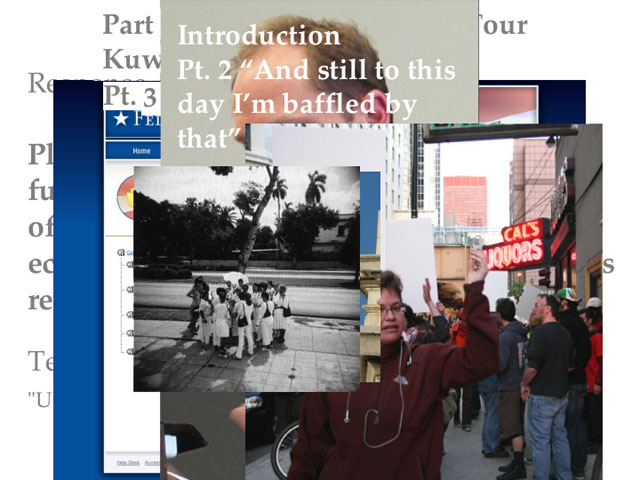
If I can invoke Cuba one more time, the crisis of activism underlying Ultra-red's performance with ambiguous white placards reminded me of a story I heard about the Ladies in White, the only open act of public protest in Cuba, consisting of a dwindling group of around twenty women dressed in white who march a three block course up and down Havana's once posh Fifth Avenue every week after Sunday mass as witnesses to loved ones jailed as opositors. The procession generally goes on without audience or impression. At one point, the Ladies in White intended to move their protest to the front of the Ministry of Justice. On that day, most of the women found themselves arrested by police as soon as they left their homes, before ever constituting an assembly. They were held only for a few hours until that day's chance to protest had passed, and released without charge or arrest. Returned home without formal record of the incident. The next week they resumed their usual processional route.19 Yet within their protest that had become heterotopic in its social acceptance as a weekly ritual, for a few hours a breach had been found. It did not lead elsewhere or other. It did not lead to freedom or imprisonment. It did not lead to social change or officially end the public protesting. It was, by Cuban political standards, a breach on all fronts. Notable as a cessation of that day's impending homotopia. And its only record rests in silence and memory.
Introduction, Pt. 3, Closing Silence
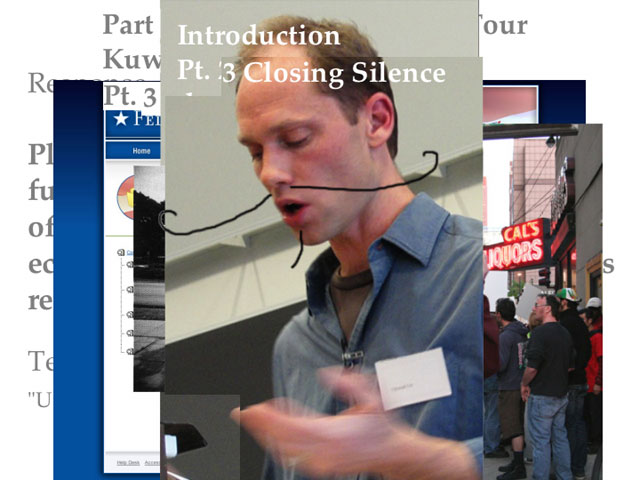
As social-minded audio producers, perhaps some of our tasks could be not honoring the heterotopic as a window into experiential otherness; to clearly understand heterotopias as regulatory aspects of the status quo; and to learn to identify homotopic processes of reconciliation and closure as we pass through them, if only to better sense the boundaries and borders of the cultural processes they facilitate. Even more important, to remember days like that of the Ladies in White in which some homotopic process or another is oddly eschewed, disclosing the boundaries within which many seek liberation only to leave us with the sound, "And still to this day, I'm baffled by that."
...I have a note here, it doesn't make much sense... While trying to wrap up this text I seem to have lost my point... It looks like I was just trying to work in key words like listen, and silence one more time... I'm sorry, this conclusion is becoming wishy-washy like Christoph's, which kind of avoided taking any stance and was politically neither here nor there... Well, I guess I'll just stop now, because what I'm saying is no longer interesting. I'm sorry, everyone. I hope Christoph doesn't hate me. I know I was just doing my job, but this symposia format is all rather anti-social when it comes right down to it... I hope they still pay me.