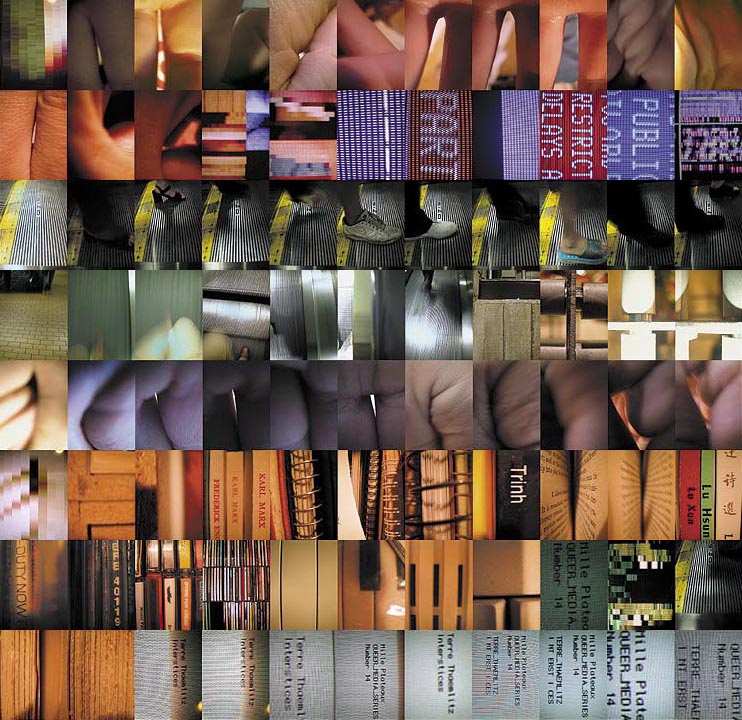
\\Mille Plateaux °QUEER_MEDIA_SERIES° Number 14 \\ TERRE THAEMLITZ I NT ERST I CES \\ \\VER. MP 44 - RELEASE DATE 11.2000 \\ \\LIST DIR\\ °01.LEFT waiting °02. Frames.001 °03. Frames.003 °04. Frames.005 °05. Systole.001 °06. Frames.002 °07. Systole.010 °08.There was a girl/there was a boy.DECLAMATION °09. Systole.009 °10. Frames.004 °11. Systole.008 °12. Systole.004 °13. Systole.011 °14. Systole.005 °15. Systole.006 °16. Systole.002 °17. Systole.007 °18. Systole.003 °19.Entre l'action et le deuil.002 °20.Entre l'action et le deuil.001 °27.Homeward.002 °21.Entre l'action et le deuil.004 °28.Homeward.003 °22.Entre l'action et le deuil.003 °29.Homeward.001 °23.Entre l'action et le deuil.005 °30.Homeward.004 °24.There was a girl/there was a boy.INTERSEX °25.There was a girl/there was a boy.WENDY (15 minutes of shame) °26.There was a girl/there was a boy.ANALSEX °31.Phase of POST MUSIC \\ \\LIST DED\\°INTERSTICES° is dedicated to BERND_LENNARTZ, in gracious appreciation of your years of tireless commitment to Mille Plateaux, and your continued friendship. I wish you the best as you move onto plateau number million and one. \\ \\LIST TNX\\This project was made possible with the kind cooperation of Ultra-red °Frames.002, Pomassl °Frames.003, Haco & After Dinner °Frames.004, Hanayo °Frames.005, eureka! °Systole.001 °Systole.009, Pesco °Systole.003, Funk Shui °Systole.010, Achim ァepanski & Mille Plateaux, Minoru Hatanaka & ICC. \\ \\LIST CRED\\Audio, text, photos and design by Terre Thaemlitz (Publishing T. Thaemlitz, BMI). Additional photo modeling by Larissa Heinrich. \\ \\°INTERSTICES°, by Terre Thaemlitz, is the fourteenth installment of the Mille Plateaux QUEER MEDIA SERIES. A portion of the proceeds from each record sold will go to support the artists involved. Coming soon, °SWITCHED ON GENDER - MOOG-SWINGS IN THE TRANSITION FROM WALTER TO WENDY CARLOS°. \\ \\Copyright Mille Plateaux 2000 °MP 94 °GEMA LC 6001 Weserstr. 7 60329 Frankfurt GERMANY °Fon: +49-69/239918 °Fax: +49-69/252280 °Email: ac@force-inc.com °URL: http://www.mille-plateaux.com/ °Released under license from COMATONSE RECORDINGS °Email: interstices@comatonse.com °URL: http://www.comatonse.com/ \\ \\LOAD ANAL\\ \\°INTERSTICES° is produced through processes I call °FRAMING and °SYSTOLIC COMPOSITION. I have used these techniques several times before, including in °Residual Expectation from °COUTURE COSMETIQUE°, °Resistance to Change - Transformative Nostalgia from °MEANS FROM AN END°, as well as °Liberation Model and °Handsome - Ballad for George Michael from °LOVE FOR SALE°. A primary goal of °INTERSTICES° is to outline the relationship between my recurrent use of these processes and the intended socio-analytical thematics of my compositions, while attempting to complicate the formalist trappings of an 'album about process' which plague so many digital synthesis and electroacoustique projects. \\On a technical level, framing refers to the manual selection and repetition or deletion of individual sample frames in a digital audio waveform. \\NOTE 1\\ Depending upon the number of frames in a selection, repetition can result in an incongruous buzzing sound, or something similar to an audio delay or time-stretching. Deletion can result in clicks, gaps and sharp edits. Similarly, as a systole in prosody means the shortening of a naturally long syllable, systolic composition procedurally refers to the shortening of sound sources by removing primary passages in order to create new compositions. It also refers to a systole as the rhythmic contraction of the heart that pumps blood out of the chambers - an ostracism of essence. \\The original sound sources used in °INTERSTICES° include jazz, funk, rock and country music. The passages most commonly deleted are vocals, figuratively silencing the dominant discourse within popular music in order to hear the interstitial sounds at their periphery. However, the result of this removal of the music's voice, heart, or life blood, is neither silence nor death. New melodies and phrases arise. Often times the remnants of a singer's inhalation and exhalation can be heard in the remaining passages, suggesting emotional, physical and/or sexual exasperation, and occasionally resulting in the whispering of new words. As a producer I am not only fond of framing and systolic composition for the sonic results they render, but because of their conceptual emphasis of sonic peripheries and moments between dominant melodic contents, as well as their construction of new words and discourses. In this manner, the results foster a symbolic relation to non-essentialist identity politics including Queer pansexuality and transgenderism. \\NOTE 2\\ But symbolic relations (is that anything like cyber sex?) have a tendency to remain removed from material exchange, and after going through all of the motions we may still find ourselves °LEFT waiting... particularly if we are waiting for the promises of the Left. \\It is when I begin audio production for a project - when I have committed to it and claimed the beginning of its identity - that I feel the most between projects. Like applying the first cold drops of foundation to my face, there is no moment when I am less masculine nor less feminine. I can control this sense of loss, determining the precise moment I enter into it. But the contrary does not hold true. I do not feel more masculine nor more feminine when I do not apply makeup. Not in a predictable way. My sense of direction is demarcated by processes of accumulative abandonment. I collect these interstitial moments, recalling them like invisible snapshots of past actions that only take shape when framed by the events which surround them. As I begin °INTERSTICES°, recent tracks for compilations, remixes, and other audio files fill my hard drives. The soundfiles are backed up. Some are then deleted. Others are moved from disk to disk in order to create larger contiguous blocks of free disk space. °Frames appear in the spaces between files, composites of beginnings and endings of the files around them, and the pauses between. Amidst this process of addition and subtraction, new source materials are also being copied to the drives, multiplying. There is often not enough room for the entire source materials to be copied. Instead, they must be reduced to key passages, becoming °Systole even before post-processing begins. Every now and then a melody arises, comfortable, overread, suggesting a familiar foundation for listening which is simultaneously eroded by what I am trying to construct. They arise like the sound of stubble peaking through my concealer. Somewhere between foundation and eyeliner, I must reconcile with this pull between concealment and portrayal. This is the moment of convolution that exists in action rather than resolution, the moment that shall be lost through the very arrival at a stage of completion,. In the end, its elusiveness and absence can depress as much as it motivates. <<Hélas!>> she bemoans through perched lips while applying her lipstick, <<... °Entre l'action et le deuil ...>> \\NOTE 3\\ \\My desire for interstitial process parallels my dissatisfaction and mistrust for conclusions as anything more than moments of demarcation. Identity is best treated as a strategy for transformation, rather than a point of arrival for truths of essence. My sense of personal advocacy cannot rely upon legislation as a means of resolving cultural disenfranchisement, no more than I can honestly claim having <<faith in people.>> More often than not, <<doing the right thing>> means acting in accordance with the Right. The U.S. has a long tradition of repealing Equal Opportunity initiatives and other protective legislation with much greater ease than the initial efforts undertaken to make them pass. Legislation intended to protect people from discrimination based on race, gender, sexual orientation, etc., are not only consistently overturned, but often followed by counter-legislation which prohibits their reintroduction. Hollow victories occupy the cracks between court hearings. Hollows of air occupy the distance between my body and feigned punches, jolting hand gestures, and cries of, <<Hey faggot!>> These pressure pockets seem to be gathering at my door with increasing frequency. Audible distortions force their way into my inner ear, to be painfully transformed into a deafening hush, throwing me off balance with dizzying nausea. I walk with the grace of an endless series of steps off of a moving escalator... and my stumbling is not just because of my heels. \\As usual, my desire to provide details regarding particular sample sources is compromised by legalities and finances. Unlike written texts which may contain <<sampled>> passages from other texts simply by referencing them with a footnote, the clarity of <<quotations>> in sonic discourse are obscured by the legal necessity to alter and conceal samples through post-processing. \\NOTE 4\\ Once again, I must find ways to distract listeners from the foundation upon which my project is built, reluctantly turning to the unreliable vagueness of sonic poetics, paraphrase, or the wording and language of a title. My use of systolic composition and other processes not only informs the content of my work, but simultaneously lays waste to many of the specifics I set out to discuss by rendering the source materials less recognizable. I am caught between processes, between intentions lost and meanings found, between eroded integrity and tedious justifications for changes in plan, between compromise and shame. I find myself operating with a sense of self-consciousness similar to that I feel when aspiring to appear as a woman, yet ever so aware of looking like a cross dresser - the knowledge that wherever °There was a girl/there was a boy. \\Declarations of content and intention become declarations of appearance, as misleading as they are revealing. An image emerges between black and white, between the left channel and the right, taking over until we are unaware of anything but interstitial greys. While I actively seek to define myself in terms of shades of grey, I am also aware that the desire to escape dominant binaries can pose the danger of creating new essentialisms. Once tones are taken to heart, they relieve us of the burden of multiplicity. In the realm of identity politics, deeply embraced appearances of gender, sexuality, race and physical ability can quickly lose their capacity for cultural permutation. Declarations turn to declamations, superfluous and rhetorical. Most people ultimately contend that their identities emerge naturally, mysteriously evolving backwards until with enough age and wisdom they can see the core of the essence from whence they came. People turn °Homeward, with all of a home's implications of FAMILIarity that liberate us from decision by confining us to familiar relations in familiar rooms. \\The appearances we so often take for granted, even for scientific fact, often come at the price of physically altering and concealing the appearance of others through social ostracism, cosmetic alteration, or even a doctor's blade. Arguments of biological difference are easily transformed into biological determinism, conforming concepts of nature to the images of those they serve. In order to preserve the integrity of a world outlook, it is easy to lose sight of cultural practice in favor of human essence, and to confuse a construction of image for a restoration of the body. For example, processes of vaginoplasty and other genital construction techniques employed as a <<correction of nature>> by the doctors and parents of intersexed children, as well as post-op transsexuals, are more often seen by intersexed persons as processes of mutilation through which they are subjugated to other peoples' concepts of <<natural gender.>> Similarly, the same double mastectomy undertaken by countless female-to-male (FTM) transsexuals is performed on countless other women for various health reasons such as breast cancer, yet the psychological counseling both parties may undergo before and after surgery point to totally different resolutions of gender - the FTM's procedure is framed as a move away from a feminine state, whereas non-transsexuals are reassured of their femininity. It is for this reason that I always advocate discussing differences - even seemingly immutable biological differences - in relation to the cultural processes through which we interpret them so as to account for the fact that one person's nature is another person's Frankenstein. The cultural sphere of audio production, which loves to portray music as a universal expression of human essence, is inextricably linked to this process of physical transformation through the ultimate post-Modern Frankenstein, Michael Jackson (...and to a lesser extent through Madonna's over-hyped transformations via hair dye). \\In my sterile operating room a body of sound lies on the editing floor, severed from the sutured figures I have produced in my own image. With the completion of the last soundfile, I enter a °Phase of POST MUSIC \\NOTE 5\\ marking the death of interstitial process. I must concede that my persistence in the conventionally formalist and a-political electroacoustic marketplace, as well as my use of a language of the body in this project's text and images, may easily betray my non-essentialist critique of them. But there are professionals ready to help me with my confusion in this time of loss - the comforting embrace of colleagues and the counselling of the press. I wait for Mille Plateaux to administer my fee with mournful anticipation like a widow awaiting closure to her late husband's estate. With a mascara tear to my 'kerchief, I know it is now time to float this reconstituted corpse upon the waters of the marketplace, where it will soon be lost in an ocean of sound.\\END ANAL\\ \\ \\LOAD NOTE\\ \\NOTE 1\\ Digital audio waveforms are comprised of a series of step-like sample frames (as a crude example, the curve of a digital sine wave is to a <<true>> sine wave like the edge of a round table-saw blade is to the edge of a dinner plate). The jaggedness or smoothness of the resulting curve is determined by a soundfile's sample rate (the number of frames that make up 1 second of audio, expressed in Hz) and bit depth (also called sample size, the number of bits used to represent a frame's dynamic range). A higher sample rate means more and shorter individual audio frames, and a higher bit depth means greater spectral detail within each frame, resulting in a smoother and more detailed wave pattern closer to that of an original acoustic sound source. \\NOTE 2\\ A discussion of the interrelationship between digital synthesis and non-essentialist transgenderism can be found in °COUTURE COSMETIQUE° (Japan: Daisyworld Discs, and US: Caipirinha Productions, 1997). Discussions of digital synthesis and Queer identity can be found in °LOVE FOR SALE° (Germany: Mille Plateaux, 1999), as well as Ultra-red's °ODE TO JOHNNY RIO° (US: Comatonse Recordings, 1998) and °SECOND NATURE° (Germany: Mille Plateaux, 1999). Issues of transgenderism and Queer identity are combined in °DIE ROBOTER RUBATO° (Germany: Mille Plateaux, 1997) and °REPLICAS RUBATO° (Germany: Mille Plateaux, 1999). All of these texts are online in the Listening Material Archive: http://www.comatonse.com/writings/index.html \\NOTE 3\\ <<Hélas! Entre l'action et le deuil.>> - Fr., trans.: <<Alas, between action and mourning.>> \\NOTE 4\\ The clearance of audio samples involves two distinct bureaucratic processes - publishing rights and mechanical rights. Publishing refers to the notes or musical score of a composition. Publishing rights are often not controlled by the composer herself, but by an agency which has contractually assumed the rights to her composition for a given period of time. Mechanical refers to the actual performance and recording of a composition, the rights to which are also typically assumed by a record label or other company. For example, if both Puff Daddy and Scanner wished to obtain clearance of a sample from Taco's 1982 techno-pop version of °Puttin' On The Ritz, they would have to obtain permission from both RCA Records for using sounds from Taco's recording, and the publishing agency which controls the original song score written by Irving Berlin. This is further complicated by the fact that publishing and mechanical rights may be held by different companies in different selling territories throughout the world (limiting where Puff Daddy and Scanner may release their cleared sample works), or rights may be assigned to an entirely different company - or no company - within a territory after the initial contract term has expired. And of course, each company operates at their own bureaucratic pace which is directly affected by their perception of the financial gain to result from the sale of Puff Daddy and Scanner's compositions. To make matters worse, the controlling companies seek to protect their investments by denying clearance for anything that might be considered a <<misrepresentation>> of the original work, including over-abstraction. So in this case, Puff Daddy (with a little help from his label's legal team) will quickly receive sample clearance for his latest elegy, °Cashin' On The Hitz, while Scanner is left wondering why nobody has returned his follow-up calls regarding clearance for his abstract treatise, °Publishin's The Shitz. If Scanner releases his project without clearance (which you know I think you should, Robin!), and if the holders of either the publishing or mechanical rights catch ear of it (typically through printed mentions in the press, not actually hearing it themselves), they will assess the economic viability of his release and then decide whether to offer him a post-manufacture clearance deal, or sue him for fines and/or the destruction of remaining inventory. \\NOTE 5\\ The title °Phase of POST MUSIC is taken from a symposium and performance series associated with the exhibition °SOUND ART - SOUND AS MEDIA°, curated by Minoru Hatanaka at the NTT InterCommunication Center, Tokyo, Jan.28-Mar.12 2000. Among others, participants included Ryoji Ikeda, Ikue Mori, Carsten Nicolai and David Toop. While the exact definition of the term °POST MUSIC remains somewhat vague (rather conveniently so), it is associated with the presentation and reception of digital audio installations and other non-performative music which does not conform to established conventions of instrumentation or staging. As the majority of participants seemed to be invested in a rather utopian pursuit of the <<advancement of sound,>> there gradually arose ambiguity as to how their embrace of the gallery space might complicate or counter their objectives of eluding artistic conventions. At the same time, some media responses portrayed the °Phase of POST MUSIC series as a failed attempt to breath new life into performativity, an association I would attribute to Modernist expectations of the gallery space's ability to reign in and make sense of abstract gestures. For myself, it was this unspoken panic over how to gauge satisfaction as producers and listeners that seemed the common link between the phases of °POST MUSIC presented. \\Voice in °Phase of POST MUSIC: <<So da... sore ga kimi no oto da... kimi no kokoro da.>> - Jap., trans.: <<So... that is your sound... your heart.>>\\END NOTE\\ \\RUN\\ \\LOAD °INTERSTICES° COMATONSE RECORDINGS VIDEO RELEASE INFO\\ \\LOAD °INTERSTICES° MILLE PLATEAUX CD INFO\\ \\LOAD ORIGINAL CD RELEASE ARTWORK\\ \\LOAD WRITINGS INDEX\\ |